One gene.
One drug.
One decade.
One billion dollars.
The current model treats each disease in isolation — most patients will never see a treatment developed in their lifetime.
One gene, one drug
No scalability, no shared learnings. Each disease starts from zero.
Economics don't work
$1B+ per drug means most rare diseases never attract the capital to begin development.
10+ years to approval
The timeline to get a drug approved exceeds what many patients can survive.
What if they're not 1,200 different diseases?
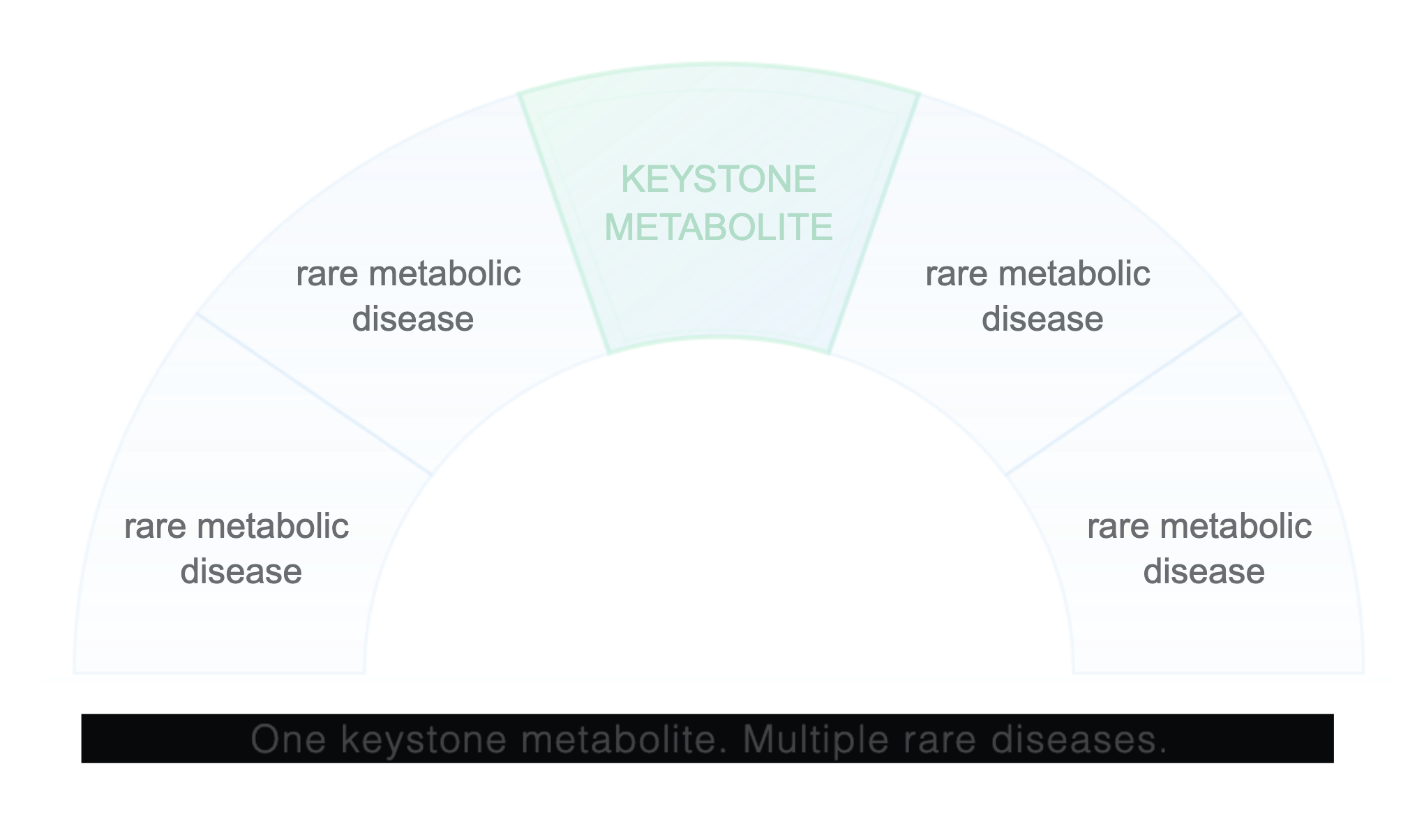
Rare metabolic diseases are genetically different, yet many disrupt the same metabolic hubs. A small set of naturally occurring metabolites can restore these hubs—and treat many diseases. We call them keystone metabolites: shaped by billions of years of evolution to work with human biology.
Keystone visual — illustration to be placed here
One keystone metabolite. Many rare diseases.
Metabolis is the first biotech discovering and developing keystone medicines across hundreds of rare metabolic diseases.
Three things just became true at once.
01
A pattern has emerged
The same metabolites repeatedly rescue distinct rare metabolic diseases. This isn't coincidence — it's biology revealing a new drug class.
02
AI-powered clinical studies
Regulatory-quality clinical data can now be generated at a fraction of traditional trial cost, through AI-powered, at-home patient studies designed to capture real-world patient outcomes.
03
Discovery is now scalable
For the first time, a single platform can systematically address hundreds of rare metabolic diseases. The bottleneck has been removed.
Our platform
Discovering keystones. Developing medicines.
Every experiment makes the next discovery faster. Our platform screens metabolites across hundreds of yeast disease models, tests rescue in yeast patient avatars and runs AI-powered at-home clinical studies — generating data faster and cheaper than traditional trials. Every result trains predictive models for the next keystone metabolite, the next disease cluster, and the patients most likely to respond.
Step 01
Discover
Screen metabolites across hundreds of yeast disease models to identify keystone candidates across rare metabolic diseases.
Step 02
Prove
Test rescue in yeast patient avatars and AI-powered, at-home clinical studies — generating regulatory-quality evidence at a fraction of traditional trial cost.
Step 03
Develop
Advance keystone metabolites into medicines across many rare metabolic diseases — stacking programs, approvals, and learnings.
3 years
From discovery to clinical trial
See how our lead program went from yeast screen to Phase 1 in three years.
DHDDS-CDG is our proof of concept: the same yeast screening platform that found NMN scales across hundreds of rare metabolic diseases, identifying the next keystone metabolites and disease clusters.
NMN (nicotinamide mononucleotide) is our first keystone metabolite in clinical development as a medicine for DHDDS-CDG — a rare congenital disorder of glycosylation with no approved treatment.
In yeast models
NAD+ precursors rescue growth defects in the DHDDS yeast disease model — identifying NMN as a candidate keystone metabolite for DHDDS-CDG.
In patient organoids
NMN restores coordinated brain network activity in DHDDS-CDG patient brain organoids — validating the mechanism in human biology.
In patients
Functional movement improvement observed in patients following 6 months of daily NMN treatment. A Phase 1 clinical trial is now underway.
Orphan Drug Designation and Rare Pediatric Disease Designation applications submitted.
Q3 2026
First Patient Dosed — Phase 1
Phase 1 safety and tolerability study underway in DHDDS-CDG patients. NCT#07572825
Q1 2027
Phase 1 Data Readout
6-month safety, tolerability, and functional data readout informs Phase 2/3 trial design.
Q2 2027
GMP & CMC NMN Manufacturing Complete
GMP drug product manufacturing, formulation and testing finalized for Phase 2/3 pivotal study.
Q3 2027
First Patient Dosed — Phase 2/3
12-month AI-powered, at-home pivotal study begins. Designed to capture real-world patient outcomes at a fraction of traditional trial cost.
Q3 2028
Data Readout & Analysis
Phase 2/3 data analyzed and pivotal data package assembled.study analyzed.
Q4 2028
NDA Submission
NDA package submitted. Rare Pediatric Disease voucher eligibility established at approval — a saleable asset that funds the next program.
$200M+
Saleable Priority Review Voucher awarded at NDA approval
7 years
Orphan drug market exclusivity, stackable across multiple disease indications
$500M–$1B+
Estimated value per approved orphan drug program
Beyond rare disease. The longevity thesis.
Rare metabolic diseases are our proving ground. When a keystone medicine rescues a severely broken metabolic pathway in a rare disease, it validates the biology in the most demanding conditions possible. The same metabolites that rescue broken metabolism in rare inherited metabolic diseases are the ones that will matter for longevity and healthy aging. Rare disease is where you prove the biology first.
Team
The team behind a new class of rare disease medicines.
We’re scientists, biotech founders, and clinical investigators who’ve taken rare disease programs from discovery to the clinic.
Co-Founder & CEO
Kristin Kantautas, PhD
Kristin believes rare disease drug development can be fundamentally rebuilt: that finding commonalities across diseases will unlock a new generation of therapies, no longer developed one disease at a time. As Co-Founder and CEO of Metabolis, she is building a new model for rare metabolic disease medicines, one designed to scale beyond the one-disease-at-a-time approach that has left most patients behind. Her discovery of NMN as a therapeutic candidate for DHDDS-CDG is now in Phase 1 clinical development, the company’s first program.
She has spent her career developing treatments for rare metabolic diseases. At Perlara, she led drug discovery and clinical translation programs for congenital disorders of glycosylation. At Cure SRD5A3, she led the translational research program, where she identified and advanced atorvastatin for SRD5A3-CDG into a global multi-site clinical study.
She also created CDG Hub, the first global knowledge platform for the congenital disorders of glycosylation ecosystem.
She holds a PhD in Molecular Genetics from the University of Toronto.
Co-Founder & CSO
Ethan Perlstein, PhD
Ethan pioneered the use of yeast-based models to find drugs for rare metabolic diseases, the same approach behind Metabolis’s first keystone metabolite.
He trained as a chemical biologist at Harvard and Princeton, then founded Perlara PBC in 2014 — the world's first biotech public benefit corporation and a Y Combinator company (W16), built to partner directly with rare disease families. He was also co-founder and CEO of Maggie's Pearl, a clinical-stage biotech developing treatments for PMM2-CDG.
At Metabolis, Ethan brings the scientific approach and the operating experience to take a rare disease platform from discovery into patients.
Medical Advisor & Study PI
Eva Morava-Kozicz, MD, PhD
Eva Morava-Kozicz is one of the world's leading clinician-scientists in inherited metabolic diseases, with over three decades of experience in the diagnosis, treatment, and clinical investigation of inborn errors of metabolism.
Professor of Genetics and Genomic Sciences at the Icahn School of Medicine at Mount Sinai, she has dedicated her career to the development of therapies for congenital disorders of glycosylation. She has led some of the first successful treatments in previously untreatable CDG types and serves as Principal Investigator of the Frontiers in CDG Consortium.
At Metabolis, Dr. Morava-Kozicz serves as Medical Advisor and Principal Investigator for the clinical studies of NMN in DHDDS-CDG patients, bringing decades of clinical expertise to the program.
Contact
Let's talk.
Metabolis is currently raising a pre-seed round.
We're looking for investors and partners who believe rare disease is the proving ground for the next generation of metabolic medicines.
 Keystone visual — illustration to be placed here


